Camel caravan

Camel caravan
Mosaic from Deir al-Adas, Syria, 8th century (photo: J.C.Meyer)
The research project Mechanisms of cross-cultural interaction: Networks in the Roman Near East (2013-2017) investigates the resilient everyday ties, such as trade, religion and power, connecting people within and across fluctuating imperial borders in the Near East in the Roman Period. The project is funded under the Research Council of Norway's SAMKUL initiative, and hosted by the Department of archaeology, history, cultural studies and religion, University of Bergen, Norway.

This blog is no longer updated, for any queries, please contact project leader Eivind Heldaas Seland

Friday, 24 January 2014

School visit: research methods in the humanities and social sciences


Yesterday I paid a visit to Bergen Katedralskole, in order to lecture and advise students in their final year of high school on research methods in the humanities and social sciences. My university each year awards the Holberg International Memorial Prize for outstanding research within these disciplines. In connection with that they also organize a research competition for senior high-school students. Bergen Katedralskole has entered two classes this year, and I am their appointed university liaison. Going there was a great chance to meet and talk with the people who will be starting college or university studies this August, and hopefully also convey why research in the humanities and social sciences is fun as well as important. For me, it was also an opportunity to think about some aspects of what we are doing and why we are doing it. 

The humanities and social sciences engage in the study of human life and culture. Their importance should be obvious, nevertheless it still has to be repeatedly emphasized and also justified. Doing research is about creating narratives. Narratives about the human experience, past and present, tell us who we are and where we come from, and in thus shaping identity, they also serve to create groups and draw boundaries between them. History, identity, and culture are continuously invoked in political and public discourse, for better and for worse. An important role of researchers is to create, uphold, question and dismantle these narratives. We do that by doing research, by teaching and by taking part in these discourses. Engaging with the distant past and far off corners of world is equally important as engaging with the present and the close by, not because we learn directly from history, but because it widens our horizon of what it means to be human, and thus allows us to better understand others as well as ourselves. That is certainly fun and useful on a personal level, but also, I think, relevant to society at large. As far as I'm concerned, there is no crisis in the humanities.

That said, those of us who are so fortunate as to make a living from research certainly have an obligation to make what we do available and relevant to the public This is also the idea underlying SAMKUL program of the Research Council of Norway, which has funded the NeRoNE project. "The glory that was Greece and the grandeur that was Rome" of Edgar Allan Poe is hardly a useful narrative of the past for the 21st century. Researching social networks in antiquity gives insights into how traditional societies work, and by better understanding historical dynamics, we also, hopefully, better appreciate how we ended up were we are, and how traditional patterns of interaction continue to influence interaction in many parts of the world, albeit to different degrees. 
As for recommending the students I met yesterday to pursue degrees in the social sciences or in the humanities, I am unapologetic. The competition they are entering now, will give them a chance to see how research is produced, and this will give them a platform for understanding and also evaluating the products of research, so often relied upon by policy-makers and bureaucrats. If they decide to go on to university studies in Old Norse, French literature, ancient history, social anthropology, or any other among the multitude of exciting subjects we can offer, the education they'll receive will enable them better to understand the world and their place in it. Few of them will continue doing research in their professional lives, but their education will train them in amassing, processing and presenting information, and it will make them highly qualified, flexible and independent candidates, able to adjust to a changing labour market for the approximately 45 years they will spend working after studying human culture and society for three to five years. 


Friday, 17 January 2014

Call for papers, session at the 2014 ASOR annual meeting

Together with Dr. Kerstin Droß-Krüpe, University of Kassel, we are hosting a session on "Sinews of Empire": Networks in the Near East" at the 2014 annual meeting of the American Schools of Oriental Research, which will be held in San Diego, November 19-22.

Here is the abstract for our session:

Sinews of empire: Networks in the Near East

This session addresses the role of networks and social relationships, as facilitators of interaction and integration between imperial, regional and local levels in the history and archeology of the Near East. Contributors are encouraged to situate their papers within theoretical frameworks that facilitate comparison between periods and empirical settings.

From the Neo-Assyrian Empire to the end of the colonial period, the Near East was dominated by a series of large, multiethnic empires, most of them centered outside the region itself. Recent studies have moved emphasis from metropolitan to regional and local points of view, but arguably most have continued to cast representatives of imperial rule as protagonists or antagonists in narratives of domination, resistance, integration and fragmentation. In recent years, a resurgence in interest in network approaches has offered new tools to conceptualize, visualize and arguably even measure interaction in past societies. In this session we aim to utilize network perspectives in an attempt to shift attention to everyday ties of business, religion, power and social interaction. How did networks develop? What where the institutions underpinning interaction and fostering integration? What impact did formal and informal rules have on interaction within these networks? How did networks react to stress on imperial level, such as invasions, economic crisis or civil war? We especially welcome papers situating data within theoretical frameworks such as Network Analysis, Social Network Analysis, Actor Network Theory and Agency Theory, in order to facilitate comparison between groups, over time and between different parts of the Near East.


If you are interested in participating, paper proposals can be submitted via ASOR's online submission system


Wednesday, 11 December 2013

A Manichaean Web

As a recently arrived co-researcher here at the NeRoNe-project I would like to give a presentation of my own work-in-progress. While Dr. Seland will be taking care of the political and economical networks, my research will deal with the emergence of new kinds of religious networks in the Roman Near East. Of course, such a huge field requires a more focused analysis. For my thesis I have chosen a case somewhat off the beaten track, namely the infamous Manichaean church. I will deal with the organization and distribution of the Manichaean network in late antiquity (roughly late 3rd–mid 7th century CE), with an emphasis on a particular community in 4th century Egypt. Here I want to give a brief survey of Manichaeism and the wider context of its development, as well as a basic sketch of the hows and whys of my project.
 

Manichaeism
Manichaeism was a religion founded by the prophet Mani (216-c. 276 CE), who grew up in a Judeo-Christian monastic community in southern Mesopotamia, then part of Sasanian Iran. After having received revelations from a heavenly being he called his Twin, Mani broke away from the brotherhood in 240 CE. In the process he began to develope his own movement and doctrines by consciously adapting and developing themes from previous prophets. The list of prophetic forerunners was long and open to emendation, but at its head were the three figures of Zarathustra, Buddha and Jesus, representing the traditions of the north, the east, and the west, respectively. Mani, from his vantage point in the ancient land of Babel, was (naturally) at the center of the world, and could therefore claim to be a universal prophet. 

Doctrines
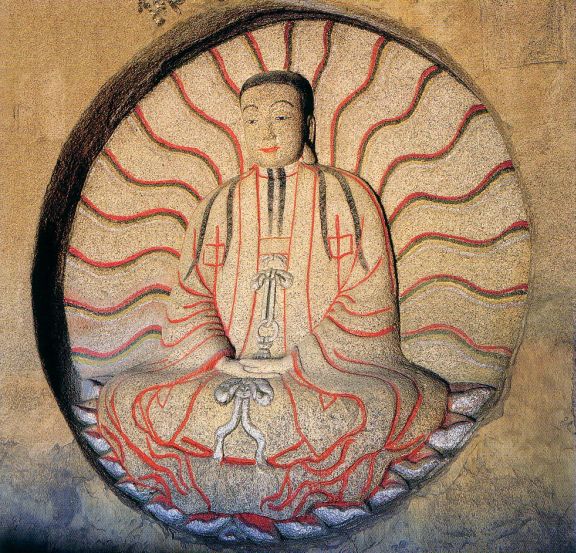
Mani, styled the Buddha of Light, at a temple in Fujian
"Prophet" is however a somewhat misleading term. Indeed, Mani himself preferred the term apostle: the apostle of Jesus Christ. In Manichaeism, both Jesus and (eventually) Mani were considered to be not only prophets or apostles, as we would understand the terms, but divine presences come to deliver a message of salvation. For Mani, every living being was part divine (identified with Light) and part demonic (identified with Darkness or Matter). Mani himself was a human with a powerful connection to the divine through his heavenly Twin; while Jesus was pure Light - though the distinction might often have been blurred. But if Jesus and the others had been sent from the same source, why was another messenger needed? The answer, according to Mani, was that their teachings had been twisted by subsequent generations. Through his divine revelations Mani had once and for all received the knowledge that Divinity had meant for man: knowledge of the first battle between the two principles, Light and Darkness, and the creation of the world from Light-trapped-in-Darkness; of the transmigration and liberation of entrapped Light (that is, souls); and of the final defeat and punishment of Darkness. An important reason for the corruption of truth was that his predecessors had not written down their doctrines. Mani would not make the same mistake. He therefore produced several books containing his revelations and interpretations, presented in myths, theological treatises, letters, hymns and paintings – none of which, in a case of historical irony, have been preserved for posterity.

Community
The liberation of Light that Mani preached was not an abstract phenomenon. On the contrary; according to Mani, it was an observable physical process that had to be facilitated by the Manichaean ascetics, the Elect, in their daily ritual lives. Liberating Light was a precondition for salvation, to be achieved through a strict ascetic life-style. This consisted of abstaining from procuring food and having sexual relations, refraining from wealth accumulation and violence towards animals, plants and humans, the constant confession of one's own moral failings, and a dietary program that included the abstinence from meat, other animal produce and alcohol. The Elect were in addition expected to participate in the church organization, preaching, producing books and establishing new communities. To assist in their work they were supplemented by the order of the Hearers. These were adherents who were not required to live by the same strict rules, but whose support and charity to the Elect assured that they would be incarnated as Elect in their next existence.


Context and Competition
Mani formed his religion in what had once been a center of civilization, on the crossroads between the at the time greatest empires of western Eurasia – in a period when both empires were going through important transitions. The Roman administration was experiencing the so-called crisis of the third century, from which it would emerge a more centralized, Christian political entity, the Republic growing ever more distant. In Mesopotamia and to the east, the Arsacid dynasty faced great internal upheavals and was replaced by the Sasanian dynasty shortly after Mani’s birth. This shift was accompanied by changes in both the political and the religious sphere. In Mani's own lifetime the Sasanian king Shapur I twice defeated Roman emperors and sacked important cities – while founding several within his own domain and centralizing the court. After his death, and paralleling to some extent the development in the Roman Empire, the Zoroastrian priesthood significantly increased their influence at the Sasanian court. 

New religious movements
Great changes were also taking place beneath what might be termed the imperial level. The empires had helped facilitate increased movement of goods and people, and with them the movement of techniques and religious conceptions. Greek urbanism in the shape of the polis had been disseminated and appropriated in large parts of the Greco-Roman world, including the Near East. At the same time, the polytheistic religion of the polis was challenged by movements which invested a new group of agents and scriptures with independent religious authority, prominent among whom were various Christian, Jewish and Buddhists groups.

Persecution
Fragment of a Manichaean church
history describing a missionary
expedition to Palmyra, Syria.
Manichaeism joined these on the road, and had by the late 3rd century spread to important cities in Central Asia and the Roman world. In the latter it became particularly influential in the 4th century, which has been characterized as “the great Manichaean century in the West” (Asmussen 1975, p. 18). The emergence of new religious movements was accompanied by increased hostility from the state, and few were more targeted than the Manichaeans. Notable examples of persecution include (but are not limited to) the campaigns of the Sasanian government in the late 3rd century, of the pagan emperor Diocletian at the beginning of the 4th, of the bishop of Rome in the 5th, of the emperor Justinian in the middle of the 6th, of Abbasid khalifs in the 8th and 9th and of Confucian officials in China in the middle of the 9th century. By the 12th century, Manichaeans seem to have been confined to southern China, where they were accused of stirring up revolts. The interaction between Manichaeans and their environment was as can be seen frequently a turbulent affair.


My Approach: Into the desert
The examination of the growth, development and disappearance of Manichaeism, especially in the west, is a field riddled with questions. Previous research on Manichaeism has been occupied with organizing source material, reconstructing the belief system, tracing its roots, or, more recently, reaching an emic understanding of Manichaean practices. These studies are of paramount importance, and any attempt at evaluating the religion without taking their questions into consideration is bound to fail. Nonetheless, my project will have a different emphasis and approach the religion from a sociological angle. The over-arching goal is to contribute to answer questions such as: How did western Manichaean monasticism develop? How strong were the institutional ties (if any) between the Manichaeans of the Middle East and those of the Mediterranean? To what extent can we speak of a unified Manichaean Church? But these issues are too broad, and the sources too sparse, to tackle head-on. To shed light on them I will make use of network theory, and concentrate on a specific community in a specific period of time, namely the Manichaean community of Kellis in the Dakhleh Oasis in south-western Egypt.

Kellis
Sources for the social life of the religion’s adherents have always been scarce. For a long time one would have to approach these questions through the lenses of Christian church authorities (notably Augustine, who spent ca ten years in the church) and the fragmented texts from Central Asia and China. With the discovery of residues of Manichaeans in the oasis village of Kellis (present-day Ismant el-Kharab) in the late 1980’s, a material that makes such an attempt viable has finally been made available. The textual remains from the Kellis-excavations consist of assorted personal letters, an account book, pieces of Greek literature, as well as Manichaean liturgical material in Coptic and Greek – and small fragments in Syriac, Mani’s own language. The letters yield a unique glimpse into the daily concerns of a group of Manichaean adherents, as opposed to the polemical, theological or liturgical texts that make up the other genuine Manichaean sources from the Roman Empire. Several letters are addressed to or written from monks, and a few contain explicit references to officials in the Manichaean church hierarchy. 

Network Theory
In my work on Kellis I will consider topics such as the extent of the Manichaean presence in the village (as well as in the oasis at large), the relationship between Manichaeans, pagans and Christians in the vicinity, and the relationship between the Kellis community and Manichaeans in other parts of Egypt. In order to do this I will be using network theory in my analysis on several levels. In the first place, network theory will help to make connections between the writers and their family members, co-religionists and associates mentioned in the letters into a systematic set of relations that can be compared and contrasted to others. With this approach I hope to model the contours of the local Manichaean network. However, the fragmented and difficult nature of the documents means that network theory will have to be used along with other sociological tools to test these models. On a more global level, network theory will be useful to approach the way Manichaeism arrived in Egypt in the first place, and its distribution and integration into the Roman world. This two-tiered analysis represents a first step in the direction of a more complete picture of the Manichaean church.


Egypt in late antiquity. Kellis is located in the south-western corner,
far into the Great desert


Why Manichaeism?  
In some ways, the recovery of a lost world religion could be seen as a goal in and of itself. But research on Manichaeism certainly has much broader implications for our understanding of ancient religion. One reason is that Manichaeism seems to me to be an especially well-suited test case for the application of network theory to ancient religion. The Manichaeans were attempting to build an international church organization from scratch, without state support (in late antiquity), - in fact under ever increasing pressure from secular and religious authorities - by what might be termed social networking. In addition, by using network theory as a framework, the successes and failures of the Manichaean church can fruitfully be compared with other religious organizations.

Manichaeism also exhibits a unique pattern for its time, with implications for the development of church hierarchies, religious identities and asceticism – and perhaps the very notion of religion. Despite its status as a “late-comer” on the religious scene of antiquity, the Manichaean church was already from the time of its founder or shortly thereafter supplied with a set of canonical books and liturgies (i.e. a daily prayer), divided into a consciously stratified church hierarchy, run – in theory – by a pope-like authority known as the archegos, organized around an ascetic notion of religious authority, with a clear missionary statement and an awareness of the need to compete with other traditions for followers. It thus exhibits features that constitute the modern institution of 'religion', and often are said to have developed or been consolidated in the course of late antiquity or even early medieval times - already combined and articulated here in one organization by the late 3rd century. 

The huge geographical spread, achieved despite ubiquitous hostility from secular and religious authorities, gives us an interesting case to contrast and compare with more well-known movements such as those under the rubrics of Judaism, Buddhism, Christianity, and Islam. It is my hope that uncovering the Manichaean network will yield valuable insights into how the "Western" conception of religion managed to spread, and came to dominate religious communities into modern times. 


Illustrations

Upper right: Mani statue from a former Manichaean (now Buddhist) temple in Fujian province. From Wang Lianmao, Return to the City of Light (Fuzhou, 2000), p. 130. Via Macquarie University.

Middle right: Manichaean manuscript in Parthian, ink on paper. © Depositum der BERLIN-BRANDENBURGISCHEN AKADEMIE DER WISSENSCHAFTEN in der STAATSBIBLIOTHEK ZU BERLIN - Preussischer Kulturbesitz, Orientabteilung. Via The International Dunhuang Project.

Bottom center: Map of late antique Egypt, from the Kelsey Museum of Archaeology's textile-exhibition. Via Kelsey Museum.


Further reading

Asmussen, Jes P. Manichaean Literature, New York: Scholars' Facsimilies & Reprints, 1975

BeDuhn, Jason D. The Manichaean Body in Discipline and Ritual, Baltimore/London: John Hopkins University Press, 2000

Gardner, Iain and Samuel N. C. Lieu. Manichaean Texts from the Roman Empire (Cambridge: University Press, 2004

Ibscher, Hugo, Hans J. Polotsky and Carl Schmidt. Ein Mani-Fund in Ägypten: Originalschriften des Mani und seiner Schüler, Berlin: Preussische Akademie der Wissenschaften, 1933

Lieu, Samuel N. C. Manichaeism in the Later Roman Empire and Medieval China, Tübingen: J. C. B. Mohr, 1992 [1986]

Sunday, 17 November 2013

Proto-globalisation in the Indian Ocean World and network approaches

Last weekend I attended the concluding conference of the ERC-funded Sealinks project. The Sealinks group, headed by Nicole Boivin of Oxford University, has investigated the early maritime links that connected societies on the Indian Ocean rim, using primarily evidence produced by archaeobotany, zooarchaeology, genetics and linguistics. Many results have already come out, and these shed light on processes going further back in time and having more profound and lasting impact, than those evident from earlier studies based on artefactual, epigraphic and literary evidence.

The conference gathered researchers working with biological and environmental proxies, along with with traditional archaeologists and the odd historian. Indian Ocean trade and navigation, as well as the  early history of globalisation being among my other research interests, I found the conference immensely informative. It struck me, however, that although almost all presenters used the N-word, there was next to no discussion on what a network is, how past networks can be approached, and what insights this might give. This is not intended as criticism of the work presented, which was generally of very high standard. In fact the observation would be valid for most archaeological conferences I've attended, and I've worked with the Indian Ocean for more than ten years myself before starting consciously to think in terms of networks myself. Indian Ocean connectivity, however, is a subject that would readily lend itself to network approaches, and in this post I'd like to share a few thoughts on how different groups of material might have benefitted from being approached from a network perspective.

Networks of people
My own research on Indian Ocean trade is primarily on merchant networks: how they formed, cohered, operated and interrelated. In my paper in Oxford I argued that merchants from the Syrian city of Palmyra engaged with local and regional social networks of power, ideology/religion and commerce, in the process of expanding their own ethnically based network from the Syrian Desert into Mesopotamia, the Persian Gulf, the Red Sea and the Arabian Sea. Our data on merchant networks are of literary, epigraphic and ceramic nature – the Palmyrene network for instance being attested by circa 50 inscriptions recording the presence or activities of Palmyrene groups and individuals in settings certainly or very likely connected with Indian Ocean trade. Similar data would be possible to utilize for other groups. Ingo Strauch and collaborators for instance recently published more than 200 inscriptions in Arabic, Indic, Ethiopic, Aramaic and Greek script from a sanctuary in the cave of Hoq on the island of Socotra. Many of these should be possible to connect with places of origin, religion, language, and script used, reconstructing the network that intersected at the node of Hoq in a manner that would be possible to approach by the toolbox of Social Network Analysis.

Networks of objects
New inscriptions are occasionally still discovered, but in general, the written evidence relevant to ancient Indian Ocean trade is delimited and finite. The archaeological data available from Indian Ocean settings, however, has exploded over the last two decades, following major excavation projects  and better practices of documenting, identifying and publishing finds. In my opinion, there are cases where distribution patterns are not necessarily well suited for network analyses, as the presence of objects does not always reveal how, when and by which routes and agents they moved from point of origin to find-spot. In the case of the Indian Ocean, however, distribution patterns clearly do have potential for network analyses, as distances, topography and climate led to virtually all communication taking place by sea. Network analysis based on distribution patterns of ceramics, beads and glass – goods that can be traced to place of production on stylistic, chemical and petrographic grounds, could clearly reveal directions, bottlenecks and clustering of trade.

Networks of places
Clearly, the same would be the case with settlements. Attempts at modeling relationships between ports and their hinterlands and between ports, based on size, kinds of imports and exports, period of occupation, distance to other centers, season of navigation etc. might help us think about why some places and some regions were important, while others seem to not to have been taking part in long-distance exchange to the same extent.

Networks of genes
Many of the papers in Oxford were on the movement of crops, animals and people, studied by way of genetic material recovered from archaeological sited. Dispersal of genes was in most cases visualized by phylogenetic trees. This is of course also a network analysis, showing genetic connections between the varieties of crops etc. found in different settings. If sufficient numbers of dated examples exist from a sufficient number of sites, I think these would also be good for showing patterns of prehistoric seafaring.

Thursday, 24 October 2013

Sunday, 20 October 2013

Workshop at Durham University: A thousand worlds...

Just back from Durham, UK, where Assyriologist and PhD-candidate in archaeology, Rune Rattenborg, hosted the workshop A Thousand Worlds: Network Models in Archaeology (follow link for program and abstracts). The workshop gathered scholars bringing data such as roads and routes, place-names, settlements, temples, agricultural estates and cuneiform texts into play using a range of different network approaches. I especially appreciated the variety of approaches represented, from Network Science over Social Network Analysis to Actor Network Theory and Michael Mann-style networks of social power. I see these approaches as complementary rather than mutually exclusive, the theories of Latour and Mann being potential tools for the qualitative analysis of the results created by quantitative approaches such as Network Science and SNA. It remains to see, of course, how feasible this is to carry out in practice.

My own paper was about the challenges of tracing dynamic phenomena, such as trade and movement, through static proxies, such as archeological finds, texts and inscriptions. Here I think network analysis has much to offer compared to traditional, descriptive analysis, as it forces us to make the assumptions underlying our conclusions explicit.

Among the highlights in Durham, by the way, was Anna Collar's presentation on religious networks in the Roman Empire. Her book on the topic is coming out on Cambridge University Press in a few weeks. Being interested in religious networks myself I promise to blog about the book once its out.


Update 28.10.13:
Tom Brughmans gives a more comprehensive summary of the workshop at electricarchaeology.ca with a highly readable discussion of some of the main questions we touched on there.

Wednesday, 2 October 2013

Publication: Networks and social cohesion in ancient Indian Ocean trade: geography, ethnicity, religion

First publication from the NeRoNE project is out. Here I discuss how merchants traveling the Indian Ocean in the first centuries of the Common Era established an infrastructure of trust by building networks based on origin, ethnicity and religion. The article is published with open access and can be downloaded for free from the publisher.

Eivind Heldaas Seland (2013). Networks and social cohesion in ancient Indian Ocean trade: geography, ethnicity, religion. Journal of Global History, 8, pp 373-390.